The Theft of the State Treasury

Lucerne, 1758. The Golden Time of the Republic was coming to its autumn. Wars and bad harvests in Europe meant that the soldier contracts, which the city lived from, were paid slowly. This made the state treasury, the heart of the Lucerne Republic, even more important.

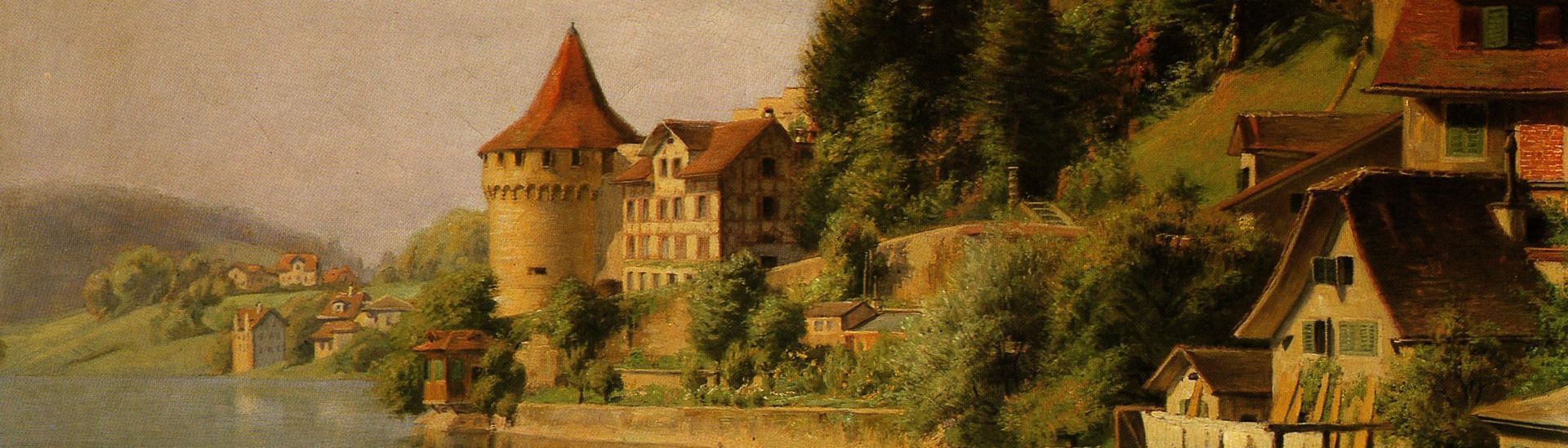
It was stored in the safest place you could think of: in the upper room of the Water Tower. The Reuss river flowed around it, and you could only reach it over the Chapel Bridge or by boat.
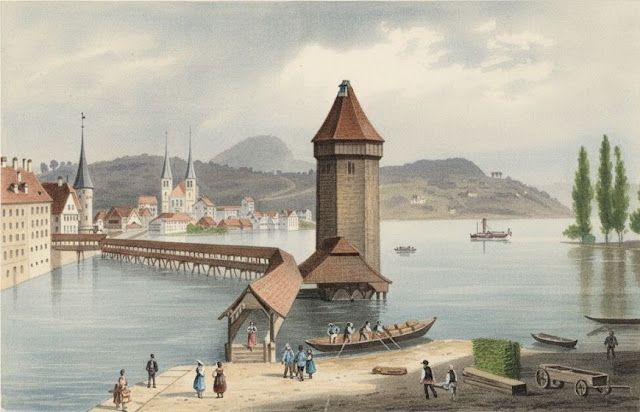
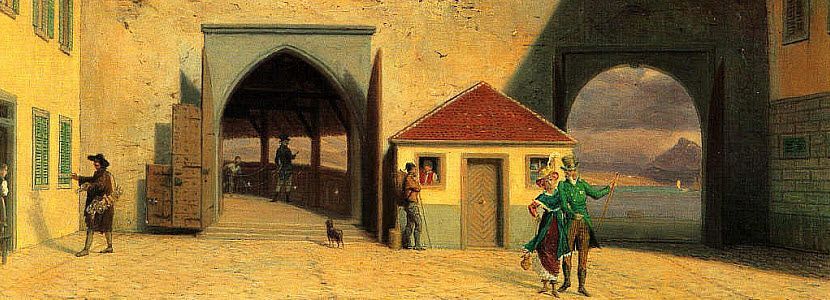
Chapel Bridge, Water Tower around 1833, lithograph by Charles-Rodolphe Weibel-Comtesse, colored


The Hole in the Attic

But no lock is safe from those who have the key. It began years before, an idea from the chaplain Beat Spengler, who was a student then. Together with his fellow student Ludwig Ales and the city employee Josef Anton Stalder, who kept the keys to the tower, they made the plan.

From the attic, they used a rope to go down into the treasure room. They drilled holes into the iron-bound chests, took gold and silver coins, and cleverly filled the bags with sand and stones until the weight was exactly right. Sometimes there were checks, but they only weighed the chests and did not check inside. They fell for the trick.


The Loan with Bad Consequences

For years, nobody found out about the theft. The theft became routine. Stalder told the new city servant Frölin about it, and soon a whole group of people knew: Stalder’s wife Maria and his daughter Veronika, Frölin’s wife Anna Maria Breitenmoser and her brother Alois, Stalder’s maid Elisabeth Bachmann, and a man named Nicolaus Schumacher.

The cheat was only found out when the Teutonic Order (Deutschritterorden) asked for a loan of 100,000 florins. The Great Council agreed on December 1, 1758.


Sand instead of Guilders

The next day, December 2, the councilmen opened the treasure room in the tower to get the loan. The quiet in the room turned to pure horror. When they wanted to count the coins for the loan, they found bags full of stones and sand. 50,000 guilders were missing – today that would be worth several million Swiss Francs.


The Hunt

The Council of Lucerne acted very hard. A hunt was started. They quickly thought it was their own employees. Josef Anton Stalder was arrested when he was trying to run away. But the city servant Frölin escaped at first.

The two clergymen, Spengler and Ales, also fled over Lake Constance. Stalder’s maid, Elisabeth Bachmann, went to Milan as soon as she heard her master was arrested. Alois Breitenmoser was also gone.

Through questioning, with and without torture, the whole conspiracy was found out. Frölin was finally found among soldiers in Hessen (Germany) and brought back to Lucerne.
.

The Price of Betrayal

The judgments in spring 1759 were merciless and were meant to scare others.
Josef Anton Stalder, the leader and a citizen of the city, was punished cruelly: his right hand was cut off, he was strangled on a post, and his body was quartered and put on the wheel.

Anna Breitenmoser was beheaded.

Jost Ignaz Frölin and Nicolaus Schumacher were hanged.

Only Stalder’s daughter, Veronika Stalder, did not get the death penalty. She was the only one who showed real regret and was sentenced to life in chains.

Sentenced and Disappeared

The executioner carried out the sentences. Chaplain Spengler, the man with the idea, later died in a monastery in Vienna in church asylum. Ludwig Ales, the organist, disappeared and was never seen again.

Two other conspirators were never caught: Alois Breitenmoser and the maid Elisabeth Bachmann. What happened to them is still 
unknown today. We only know that Breitenmoser fled early and Bachmann made it to Milan.


For the sources please refer to the German version of this post.

By Ralf Fioretti December 4, 2025
Mount Pilatus strongly stimulated the imagination of the people in Switzerland early on. This was because it seemingly rose gently from the flatlands, but then suddenly jutted steeply upwards in massive rock formations. The ancients called it "Fractus mons" (broken mountain) or Frakmont . They considered it nothing more than a split and broken-up mighty hill. Since the people of antiquity could not explain the elemental forces that once split the mountain, they saw in them the work of evil powers. Because fire, water, storms, and lightning had always terrified the residents, they believed that these forces were causing mischief on the mountain. In the ignorance of the Middle Ages, one thing was clear: spirits lived there. In the stories, one heard of dragons, ghosts, spirits, hobgoblins (Herdmännlein), and mischievous dwarves (Toggelis); even the Türst and the Sträggele caused trouble there.
November 10, 2014
The Alte Suidtersche Apotheke (Old Suidtersche Pharmacy) was founded in 1833, and parts of the interior haven't changed since then. Customers from near and far are served in an antique setting. The pharmacy also offers its own house specialties, such as the well-known "Mother and Child" skin balm. The real highlight, however, is the medieval display window. During the day, you can hardly see anything because there are no lights on inside. But at night, a medieval pharmacy is revealed. You can see shelves filled with jars and containers featuring labels and symbols, bones, jawbones with teeth, an old medical book, and an eagle owl. Hanging from the ceiling are dried remedies, wood, roots, a pufferfish, and the "Pilatus Dragon."
October 25, 2014
Around the 18th century, a new idea appeared: minor offenders were made to work for the public. This punishment was called “Schellenwerk.” The word “Schelle” means clamp . People sentenced to the Schellenwerk were put in chains, and the chains had metal clamps that made noise. They also had to wear a heavy iron neck ring with a large clip, called the “beak.” This made them easy to see and hear. During the day, the Schellenwerker had to do hard physical work, such as construction work or repairing the dam. In winter, this often meant standing in cold river water. At night, they were locked into the Weggistor , a gate at the end of today’s Hertensteinstrasse. Historical reports say that the Schellenwerk was also used to force lazy or work-shy young adults to work.
September 20, 2014
In the Middle Ages, every city had a pillory. It was used to punish minor crimes. The offender was chained to the pillory for a certain time so that the people could mock him, spit on him, and throw dirt at him. Being “put in the pillory” was a punishment of shame. Beatings, branding, and mutilations were also carried out at the pillory. For people sentenced to death, the pillory was only one stop on the painful way to execution. In Lucerne, a pillar pillory stood in the lower part of the old fish market. The iron neck rings that belonged to it are shown in the Historical Museum. The pillory itself no longer exists, but it can be seen in the Martini Plan of 1597.
August 18, 2014
At the end of the 18th century, the French invasion brought French law to Switzerland. Criminal law in Lucerne was reformed. The pillory, branding, and whipping were abolished. For executions, the guillotine was introduced. The guillotine was unpopular in Switzerland. It was seen as cold and foreign. The sword was considered noble and honorable, and for a time executions returned to the sword. Eventually, the guillotine became the standard method. Executions were no longer public and took place in the prison yard on Baselstrasse. At first, Lucerne did not own a guillotine and had to borrow one. Later, the city bought a guillotine and lent it to other parts of Switzerland. The last five executions in Switzerland were carried out with this guillotine. Today it is displayed in the Historical Museum of Lucerne. The last civilian execution in Lucerne took place in 1910. Anselm Wütschert was executed by guillotine. The last civilian execution in Switzerland took place in 1940, when Hans Vollenweider was executed in Sarnen with the Lucerne guillotine. After that, the guillotine was no longer used.