The House "Zur Gilgen" and its Gothic Round Tower

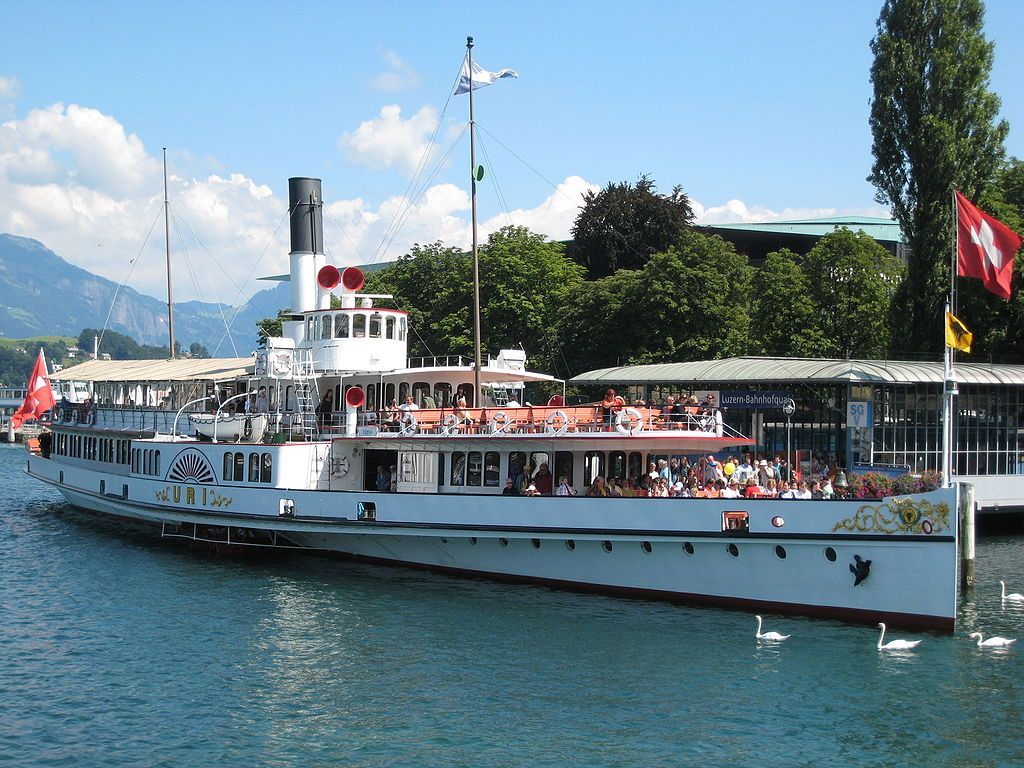
When you stand at Schwanenplatz in Lucerne, you will notice a special building right away: the house “Zur Gilgen” with its round tower. It stands at Kapellplatz 1, between the River Reuss and Schwanenplatz — right in the heart of the old town.


A medieval tower becomes a stone house

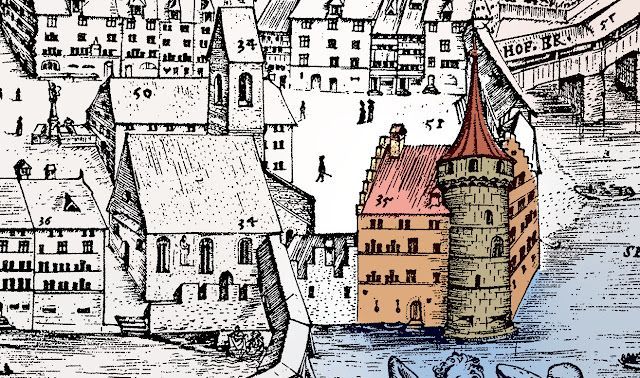
Long ago, a wooden defence tower stood here as part of Lucerne’s city walls. After it burned down in 1505, Melchior Zur Gilgen built today’s stone house and tower between 1507 and 1510. It is the oldest surviving stone house in Lucerne.


Melchior Zur Gilgen was a soldier, military leader, and diplomat. He died of malaria in 1519 on his way home from a pilgrimage to Jerusalem and was buried on Rhodes.


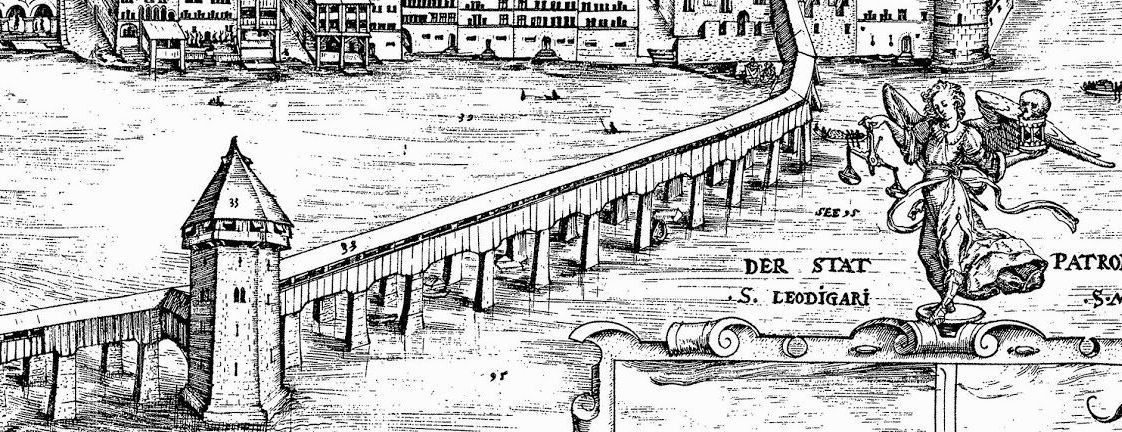
Zur Gilgen House and Baghard Tower, Martini Plan 1597

Special features of the building

 The house is built in the late Gothic style. Many details once had a practical use:


  • Stepped gable
    A tall roof wall that helped stop the spread of fires.
  • Gothic windows
    Decorative grouped windows shaping the façade.
  • Gun slits in the tower
    The wide openings at the bottom are firing slits. They were built for early firearms. The reason they are so low today is simple: the tower once stood directly at the water of the Reuss River.  From there, the guards could shoot low across the river to hit attacking boats at the waterline.
  • Chapel inside the tower
    With a beautiful Gothic vaulted ceiling.
  • Very steep roofs
    Typical for Gothic architecture — symbolically “pointing to heaven.”


The house also contains the oldest private library in Switzerland still preserved in its original location.
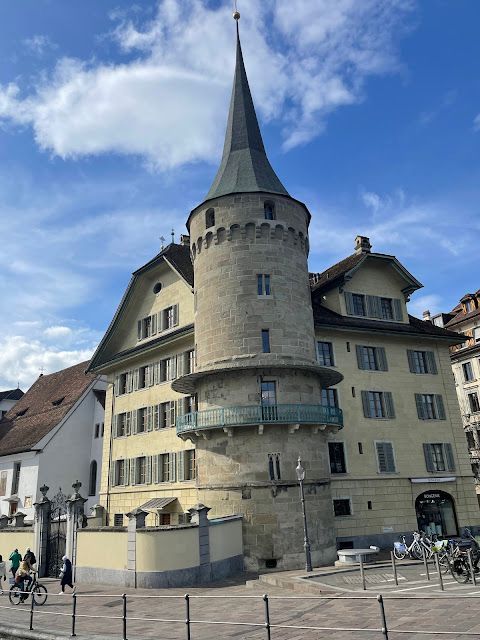

Zur Gilgen House and Tower, Schwanenplatz Lucerne


Changing times

Over the centuries, the building had many uses:

  • 1732: renovated in Baroque style
  • 1830–1836: residence of the Pope’s ambassador
  • Later: a guesthouse — even Victor Hugo stayed here


For many generations, the house was kept inside the Zur Gilgen family through a special legal tradition.


Today

Since 2013, the building belongs to the Foundation “Haus und Turm Gilgen.”  This helps preserve the house for the future — and one day it may be opened to the public.


Details on the tower
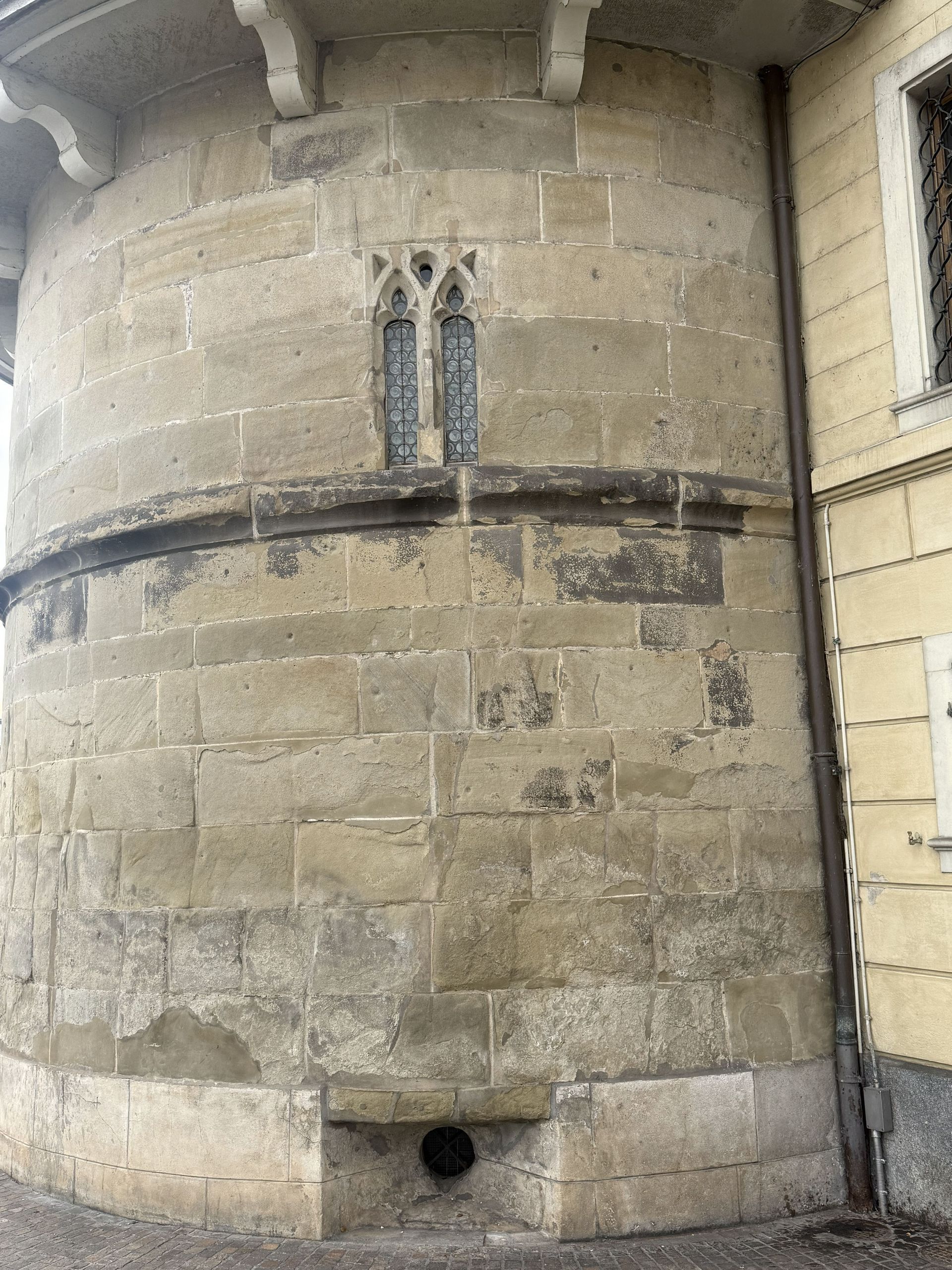
Loop-holes, a Biforium, and Lewis Holes, Zur Gilgen Tower
  • Twin window (biforium):
    Gives the tower an elegant, historic look and shows it was also used for living.
  • Gun slits:
    The wide openings at the bottom are firing slits.  They were built for early firearms.
    The reason they are so low today is simple: the tower once stood directly at the water of the Reuss River. From there, the guards could shoot low across the river to hit attacking boats at the waterline.
  • Stone-lifting marks:
    Small holes show where lifting tools held the heavy stones.


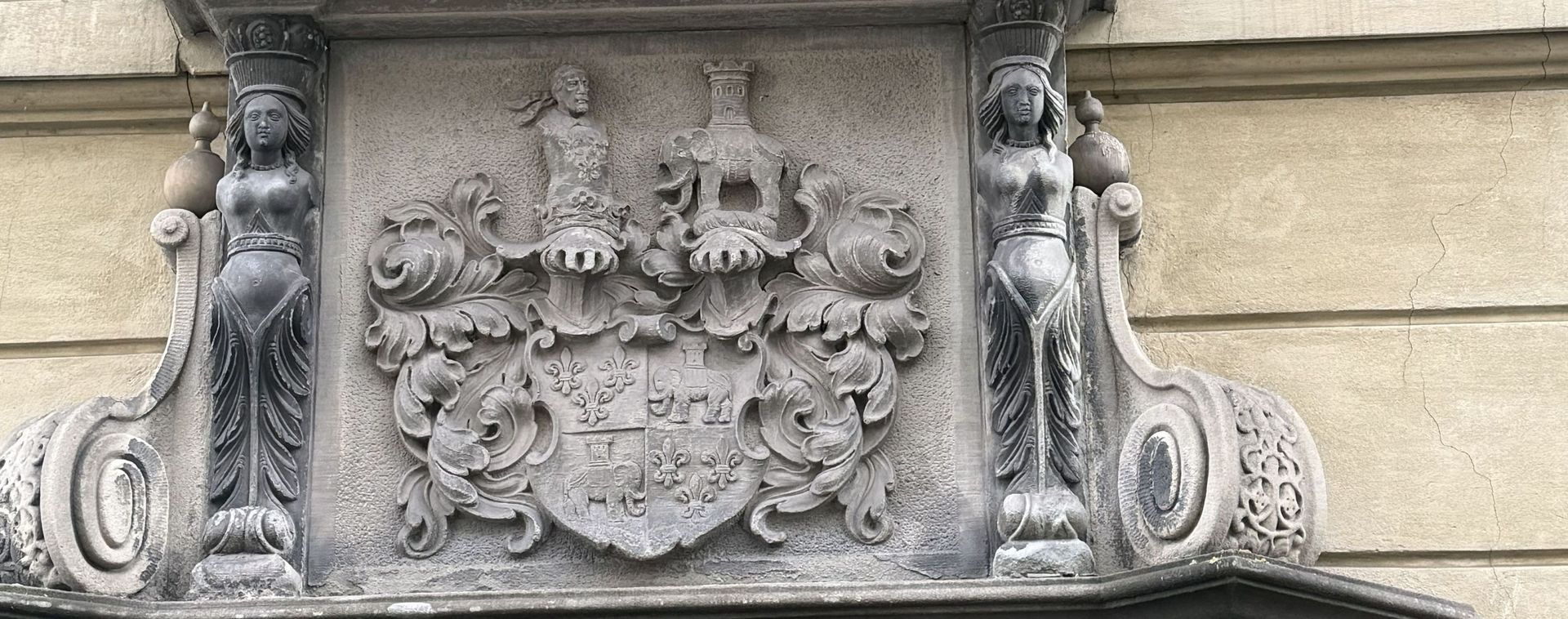
Above the entrance, you can see the Zur Gilgen family coat of arms, decorated with two female figures.
Schiessscharten, ein Biforium und Zangenlöcher, Zur Gilgen Turm

Sources (all in German)


Historical Dictionary of Switzerland (HLS):
“Zur Gilgen, Melchior.”
https://hls-dhs-dss.ch/de/articles/014132/2014-02-24/
“Zur Gilgen (Family).”
https://hls-dhs-dss.ch/articles/022219/2015-11-17/


Christian Hodel: “Fehlende Erben – Stiftung sorgt nun für Zurgilgenhaus", Luzerner Zeitung, 22. Mai 2015
https://www.luzernerzeitung.ch/zentralschweiz/luzern/stadt-luzern-fehlende-erben-stiftung-sorgt-nun-fuer-zurgilgenhaus-ld.8857


Wikipedia: “Haus Zur Gilgen.” https://en.wikipedia.org/wiki/Haus_Zur_Gilgen


Also drawing on my own research.

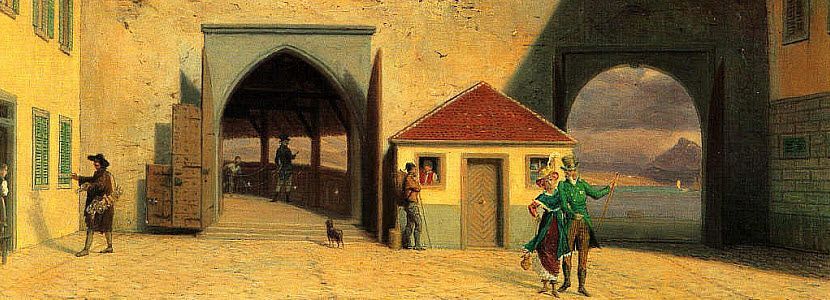
The Gates to the Hof Bridge and the Boat Landing - Xaver Schwegler
By Ralf Fioretti January 6, 2026
The painting “The Gates to the Hof Bridge and the Boat Landing” by Xaver Schwegler (1832–1902) shows the view from the lower Kapellplatz toward the lake, the way this place looked around 1834 . Schwegler painted the picture around 1900 , using a drawing by his father Jakob Schwegler , who had seen the scene himself. On the right side of the painting is the Zur Gilgen House . Next to it is part of the old city wall with two gateways :  The left gateway , with a pointed arch, leads to the Hof Bridge . The right gateway , with a round arch, leads to the boat landing . Through this round arch you can see Mount Rigi in the background.
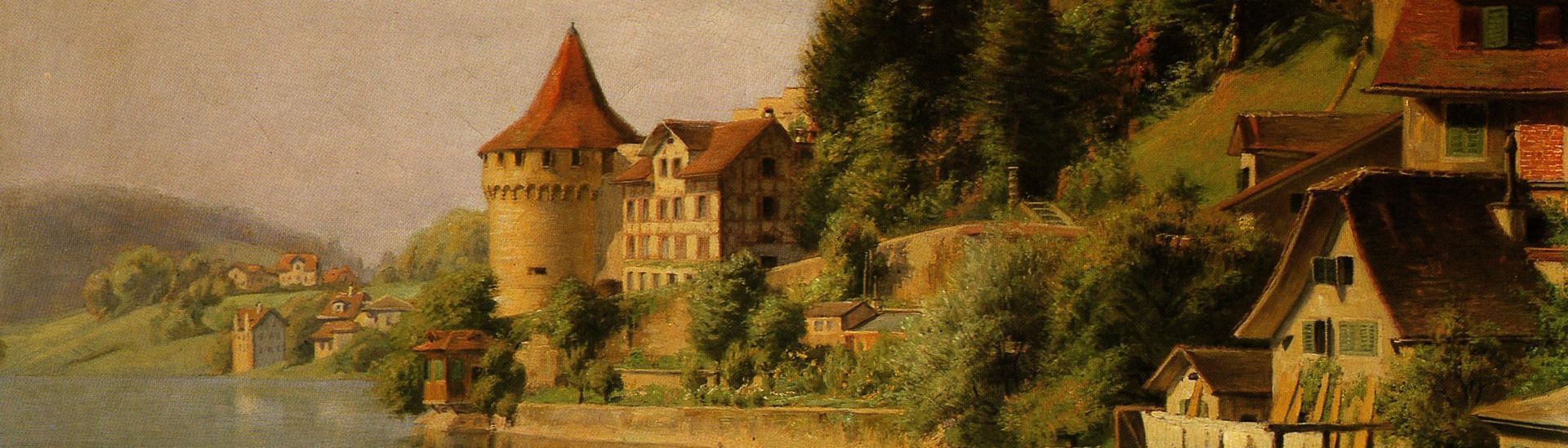
The Nölliturm — Joseph Clemens Kaufmann, 1901
By Ralf Fioretti January 5, 2026
This painting is by Joseph Clemens Kaufmann and is dated 1901 ( oil on canvas, 58 × 76 cm ). The artist was probably standing on the Spreuer Bridge when he painted this beautiful scene. It shows the right bank of the River Reuss below the bridge around 1890 . At the centre of the painting stands the Nölliturm , built between 1516 and 1519 , marking the lower end of the Musegg Wall . Because of its bright red tiled roof, it was once called the “Red Tower.” The painting shows a time when the riverside was still quiet, natural, and free from traffic – the St. Karli Quay and the Geissmatt Bridge did not yet exist. The river lies calm in the warm sunlight, the houses reflect in the clear water, and gardens and old trees rise up on the hillside. The whole scene feels peaceful and timeless , as if everyday life had paused for a moment.
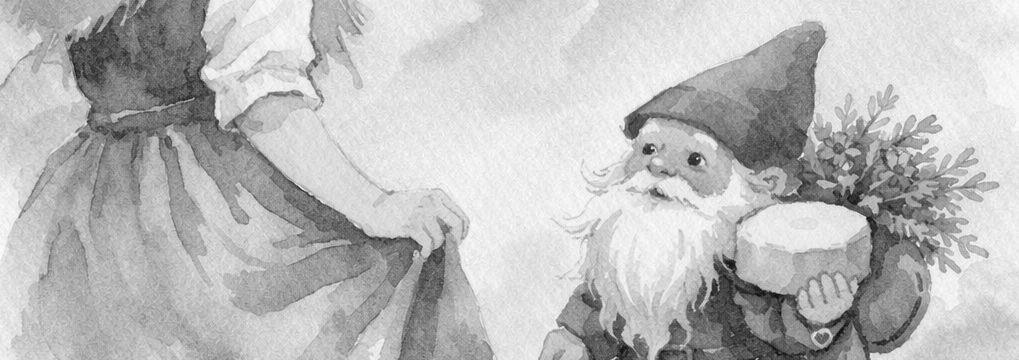
The Little Earth Man gives Magdalena a cheese and some healing herbs.
By Ralf Fioretti January 3, 2026
Long ago, on Mount Pilatus , there lived little mountain men . They lived inside the whole mountain , from the top down to Hergiswil and the Eigental. They could suddenly come out of caves and disappear again very fast. They were very small and wore green clothes and red hats . Their feet looked like goose feet . They had long white hair and beards down to the ground . They looked after animals and fish and helped the farmers . But if someone was unkind to them, they took revenge very quickly . On the Kastelen Alp , there once lived a rich farmer named Klaus . One day, Magdalena came to him. Her mother was poor and sick . Magdalena asked Klaus for help. But Klaus only laughed at her . So Magdalena walked sadly down the mountain. On the way, she met a farm boy from the Bründlen Alp . He saw how sad she was. So he gave her his only small cheese .
The Little Earth-Woman and the poor Widow
By Ralf Fioretti January 3, 2026
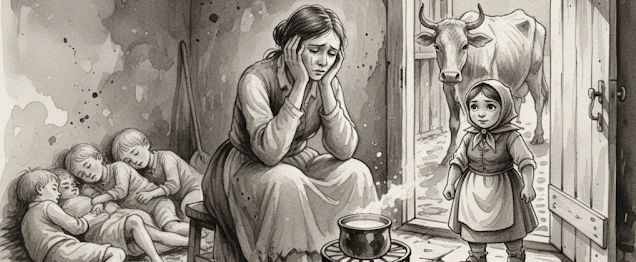
In the valley of the Hilfern , on the western slope of the Schratten near Marbach , there lived a poor widow in a very small and crooked little house. Often she did not know how she could feed herself and her children. She owned only one cow , and in the attic there was just a small, thin pile of hay.
© Lucerne Tourism / Ivo Scholz | Switzerland Tourism
By Ralf Fioretti December 4, 2025
Mount Pilatus strongly stimulated the imagination of the people in Switzerland early on. This was because it seemingly rose gently from the flatlands, but then suddenly jutted steeply upwards in massive rock formations. The ancients called it "Fractus mons" (broken mountain) or Frakmont . They considered it nothing more than a split and broken-up mighty hill. Since the people of antiquity could not explain the elemental forces that once split the mountain, they saw in them the work of evil powers. Because fire, water, storms, and lightning had always terrified the residents, they believed that these forces were causing mischief on the mountain. In the ignorance of the Middle Ages, one thing was clear: spirits lived there. In the stories, one heard of dragons, ghosts, spirits, hobgoblins (Herdmännlein), and mischievous dwarves (Toggelis); even the Türst and the Sträggele caused trouble there.
Martini Plan 1597, detail
By Ralf Fioretti November 15, 2025
Lucerne, 1758. The Golden Time of the Republic was coming to its autumn. Wars and bad harvests in Europe meant that the soldier contracts, which the city lived from, were paid slowly. This made the state treasury, the heart of the Lucerne Republic, even more important.  It was stored in the safest place you could think of: in the upper room of the Water Tower. The Reuss river flowed around it, and you could only reach it over the Chapel Bridge or by boat.
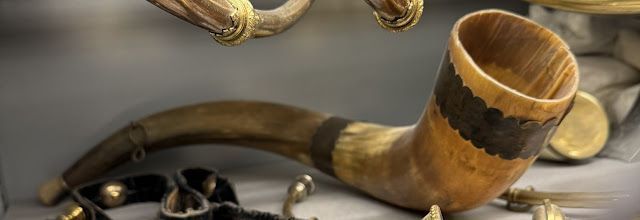
The war horn in the Historical Museum Lucerne, Photo: 12Nov25.
By Ralf Fioretti November 14, 2025
A painting on the Chapel Bridge (panel Nr. 25) once showed a famous Lucerne legend: The Emperor Charlemagne giving special "Harsthörner" (war horns) to warriors from Lucerne to honor them. (Please note: This original painting was unfortunately destroyed in the 1993 Chapel Bridge fire and is no longer on the bridge.) The legend says that in 778, warriors from Lucerne joined Charlemagne’s army in Spain. They bravely saved his nephew, Roland, in a battle. As a "thank you" for their loyalty and courage, the emperor gave them the special war horns, a great privilege.
Riese von Reiden Johann Leopold Cysat Vier Wald Staettersee 1661
By Ralf Fioretti November 9, 2025
A famous painting on Lucerne's Chapel Bridge (Panel No. 1) shows an old city legend. It pictures a giant man with a tree trunk standing next to a normal-sized man.
Lucerne Schilling, 1513, Folio 210r (P.425). A servant in Bellinzona, who wanted
to betray the city
By Ralf Fioretti November 8, 2025
Just like any good craftsman, the executioner tried to do a "clean" job. When it came to torture, he was only allowed to go as far as it was useful—he wasn't supposed to kill them. The executioner had to be extremely careful that the tortured prisoners didn't die, so they could still be brought to their "real" punishment.
Luzerner Schilling Folio 174v (P. 352), detail
By Ralf Fioretti November 6, 2025
In the beginning, as serfs of the Hofkloster (monastery), we got our judgement at the Marienbrunnen (Mary's fountain) by the stairs of today's Hofkirche. From the middle of the 13th century, the Habsburgs allowed us to hold court ourselves . This happened at the lower fish market (unterer Fischmarkt), by the court linden tree. Later, the first town hall of Lucerne (the building before today's Hotel Des Balances) became the court place. The executions happened at the Sentimatt execution place .